 Relokea
Working in Switzerland, profession by profession
A nurse in Annemasse, a driver in Pontarlier, a developer in Lyon: the question is the same. What is my profession worth on the other side of the border? It comes down to three answers: what it really pays (in Swiss francs, not in roughly converted euros), whether it’s really in demand, and whether your diploma is recognised there as is. This page answers all three, profession by profession, with dated sources.
The three questions to settle before applying
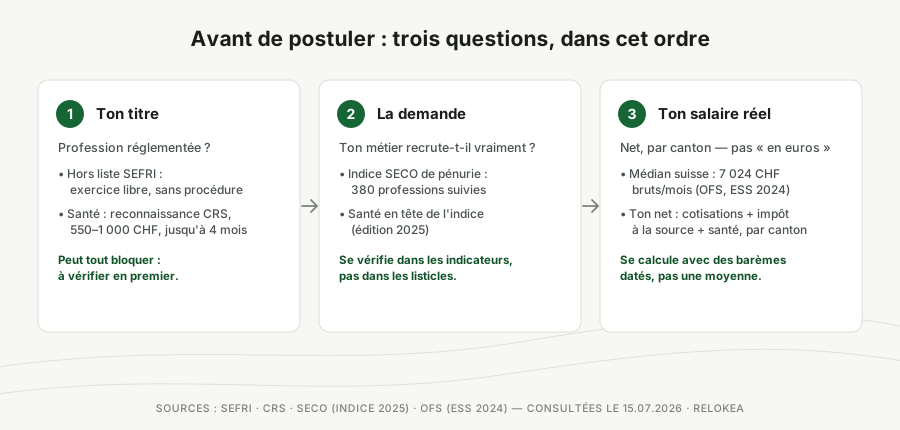
You’ve seen the headlines: “10 professions hiring up to €6,500”. They answer a question no one asks, with amounts no one receives. Before you send a single CV, you need three precise answers — in this order: the qualification first (it can block everything), then demand, salary last, because a salary is only well negotiated with the first two answers in hand.
What your profession really pays (and why euro amounts mislead)
The Swiss median salary is 7,024 CHF gross per month for a full-time position (Swiss Earnings Structure Survey 2024, FSO). This figure tells you almost nothing: it mixes cantons, sectors and agreements — only the salary of YOUR profession in YOUR canton counts.
Healthcare professions: demand is real, the qualification is the key
A nurse from Annemasse aiming for the HUG won’t lack positions: healthcare professions are at the top of the Swiss skilled-labour shortage index (SECO, 2025 index). What she may lack is the open sesame: for non-university healthcare professions, everything starts with recognition of the qualification by the Swiss Red Cross (CRS). The procedure starts with a free, mandatory online PreCheck; budget 550 to 1,000 CHF depending on your profile (+ 130 CHF register entry), and up to four months for a first decision once the file is complete.
Nurse
CRS recognition mandatory — reduced fee of 550 CHF if your diploma is listed in Annex V of Directive 2005/36/EC. In Geneva, the dominant employer is public (HUG), salaries on a public grid. → Nurse in Geneva: the complete path
Healthcare assistant
Careful: the French title (DEAS) doesn’t transfer as is. The closest Swiss equivalent is the ASSC (healthcare and community-care assistant), a three-year training — compensatory measures frequent, B1 level in a national language required. The difference changes your salary and your tasks. → Healthcare assistant in Switzerland: the ASSC equivalence trap
Is your profession regulated? The short answer
A regulated profession requires official recognition BEFORE practising. The indicative list of regulated professions and the competent bodies are kept by SERI — and any profession outside this list is practised freely, without prior procedure. The logic in three cases:
- Regulated profession (health, teaching, certain technical trades): recognition mandatory — budget several weeks to several months.
- Non-regulated profession (the majority: commerce, IT, administration…): the employer decides. Your diploma is “translated”, not recognised.
- Protected title without a regulated profession: you can practise, but not use the title.
Transport, logistics, construction
Heavy-goods driver file (licence, ADR, agreements) in preparation. The fundamentals of this family: frequent collective agreements (CCT) — their minimum wages are binding when declared generally binding —, strong canton sensitivity, demand tracked in the SECO indicators.
IT, engineering, finance
Developer / data / IT file (salaries by canton, recruiter expectations, tech CV) in preparation. The fundamentals: mostly non-regulated professions, salaries widely dispersed by canton and sector, English often enough in Zurich and Geneva in tech — not elsewhere.
The same profession, two lives: cross-border or resident
At equal profession and salary, your status changes your net, your taxes, your health insurance and your daily life. Start with the cross-border hub or the relocation hub depending on your track — and compare the two before deciding.
Key takeaways
- Three questions before applying: your qualification, demand, your real salary — in that order.
- The “euro” amounts of listicles compare incomparable things: calculate your real net.
- Healthcare professions: CRS recognition is the starting point, not a formality.
- Most professions aren’t regulated: there, it’s your application file that decides.
Practical tips
- Check whether your profession is regulated BEFORE preparing your applications — in that direction, not the reverse (SERI indicative list).
- Ask for the grids or the CCT of the target sector: in Switzerland, many salaries can be looked up, not guessed.
- Calculate your net in TWO target cantons: the difference sometimes pays for the move.
Common mistakes
Frequently asked questions
Calculate what your profession really pays. Gross salary → real net, contributions and tax at source included, by canton — official 2026 rates, dated and sourced.
Official sources
- FSO — Swiss Earnings Structure Survey 2024 (accessed 15.07.2026)
- La Vie économique (SECO journal) — Skilled-labour shortage: the occupations most affected (BSS/KOF study, 2023) (accessed 15.07.2026)
- CRS — recognition of foreign diplomas (accessed 15.07.2026)
- SERI — regulated professions (accessed 15.07.2026)
Related guides: The Swiss CV · Applying in Switzerland · Healthcare salaries · Cross-border hub
All the guides in this path
Regulated professions in Switzerland: is yours one?
Most professions need no authorisation in Switzerland. The exceptions by family, and which authority is competent for each sector.
Care assistant in Switzerland: the ASSC recognition trap (2026)
Your French DEAS doesn't transfer as-is: full ASSC recognition or the faster Swiss Red Cross care-aide route — two paths, two salaries. Costs and timelines.
Nurse in Geneva: salary, SRC recognition, hiring (2026)
Swiss Red Cross recognition (costs, timelines), the public salary grid, Geneva employers, cross-border status: the complete path to a nursing job.